




Open-source software can help digital sovereignty, but it is not enough. Many of the calls of open source enthusiasts, in my book, are even hurting, because they simplify and promise what can’t be promised.
Myth: Open-source software will remove vendor lock-in and will make switching to alternative suppliers easy.
Truth: All software locks you in, and real solutions are more than just software, so costs just shift to another layer.
As the professor of open-source software at FAU Erlangen, I consult to public agencies on how to improve their software fate using open-source software. As a consultant at Bayave GmbH I consult to vendors on how to maximize lock-in in the face of an open source purchasing requirement. You just can’t ignore reality.
Most vendors run circles around public servants tasked with buying software. “Of course it is open-source software! We just don’t provide the build instructions. Nor the container images. Nor closed dependencies. Did I mention the need to update cryptographic keys? Or the upgrade scripts?” And so on. Every day, there is something new, and human creativity will keep it going. And as long as public servant salaries severely lag commercial ones, this tug of war will remain woefully unbalanced. Enthusiasm only goes so far.
As an educator of young programmers, I also worry for their professional and personal well-being. A world in which product developer salaries are squeezed to the minimum is not a world I want to prepare young minds for.
What is missing from the debate about open source and digital sovereignty is a comprehensive understanding. This illustration taken from my commercial workshop on the open source business shows you how, if you squeeze software, the money will just shift to another layer.
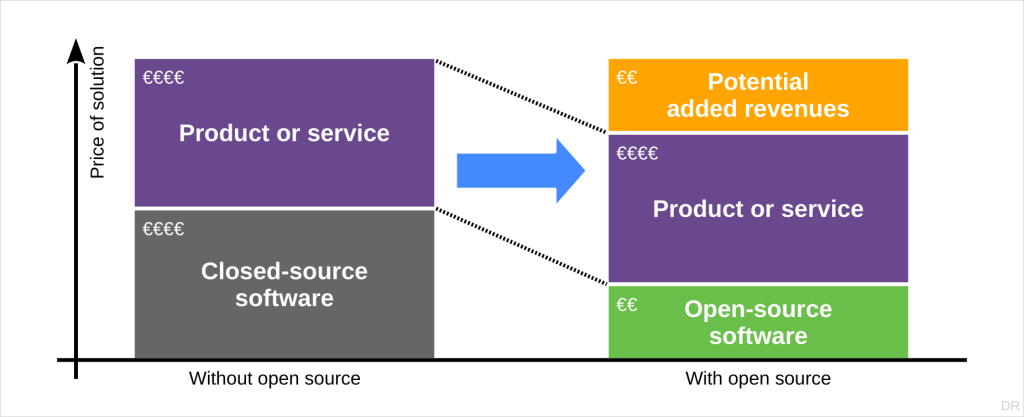
I usually call “another layer” the closed complement that you don’t get for free if you are talking to a commercial enterprise. Labor, cloud service, computing hardware, you name it. Industry has long understood this. That’s why Intel supports Linux [1], IBM supports Java / Eclipse, and Google supports Kubernetes.
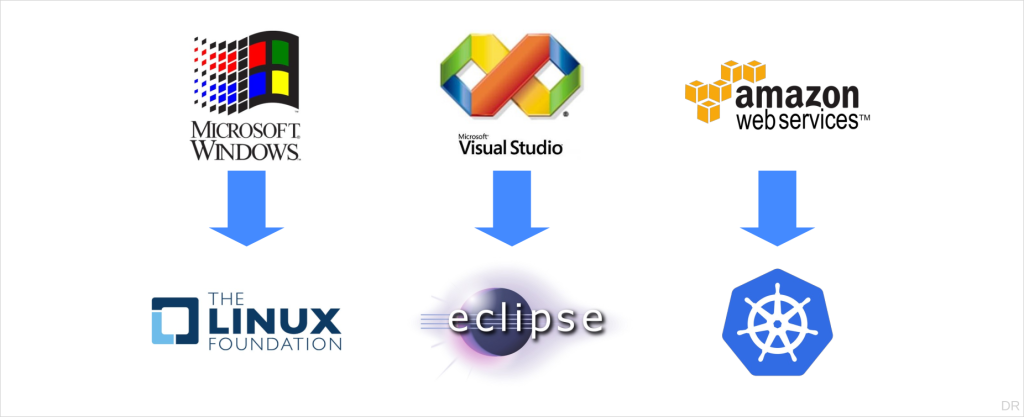
Smart companies know how to price to capture as much customer value as is possible. Software prices just dropped because of open source? Hardware is more expensive now. Switching costs dropped because of open source? Consulting labor fees just shot up.
As long as public agencies don’t have a comprehensive understanding of how the industry works, the effects of a public open source requirement will remain limited and just hurt the people I’m educating.
At a minimum, I look forward to an open hardware mandate and to better support for educating developers. But it is just a beginning.
[1] As a historical note: I originally developed this image 22 years ago in a course with Andy Grove and Robert Burgelman while I was an M.B.A. student at Stanford.




Leave a Reply